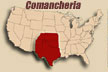
June 26, 1850; Guerra, Texas: In February 1850 the Texas Rangers decided to reorganize. Capt. John S, Ford moved some of his men from the Corpus Christi area to a new camp at San Antonio Viejo, in present-day southwestern Jim Hogg County. The camp, at the southern edge of a large sand belt extending across Nueces, Texas, was built in a stand of oaks, near several large natural wells of clear water.
When Ford learned of Walker's fight, he decided to take part of his force to link up with Walker in Laredo. He left Lt. Malcijah B. Highsmith in command of the camp, which comprised ten rangers and various employees and teamsters, for a total of twenty-six men. He instructed the lieutenant to keep a constant watch for Indians. A week after Ford left, the camp was indeed attacked. Ford's servant, Don Francisco de la Garza Falcon, whom the rangers called "Monkey" and who often regaled them with his imaginary feats of heroism, heard cattle bellowing up near the wells. When he went out to investigate, he saw the dust of about 200 fast-approaching Comanches. The rangers made a hasty barricade and took defensive positions around their square of tents.
As the Comanches circled, Ranger Hardy fired first, bringing down a warrior. The Indians pulled back and began a long-range siege. Luckily the Texans had recently restocked their water supply and had plenty of provisions. The Comanches stole ten horses and five mules, but they could not break into the rangers' camp as the outnumbered defenders held their perimeter. Falcon and mule driver August Harmuth climbed the little barricade and taunted the Indians to come and fight. Falcon closed his eyes and fired blindly several times, asking after each shot, "Did 1 kill one?" With each negative response, Falcon cursed his pistol.
The siege lasted a few days. The Indians left at the approach of Capt. Joseph H. La Motte with a detachment of First U.S. Infantry from Ringgold Barracks. La Motte came to the rescue after the rangers' Carrizo Indian guide broke away from the besieged camp and rode hard to the barracks, which were about forty-five miles south. As he headed out, La Motte sent word upriver to Ford in Laredo. When Ford learned about the siege, he and his rangers hurried the nearly seventy miles back to the camp, but once there he found the situation already under control.