Ca. August 1, 1867; Loving, New Mexico: Charles Goodnight and Oliver Loving, two cattlemen from Texas, were
the first to drive large herds of longhorns from Texas to New Mexico,
Colorado, and Wyoming, blazing cattle trails that would secure their
names in history. During their second season of cattle drives, Loving
became impatient with the slow progress of the cattle moving up the
Pecos River. It was late July, and contracts were to be drawn up in August for next year's drive, so he had to get to Denver to make arrangements. He decided to leave the main herd and move ahead on his own. Goodnight cautioned against it, but Loving's mind was made up. He and Bill "One-armed" Wilson saddled up and moved north.
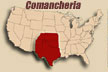
The pair rode by night, passing Pope's Crossing near the present-day Texas-New Mexico state line, then taking the high trail across the Delaware River and over to the Black River. Loving detested night riding, and since they had seen no sign of Indians, he talked Wilson into riding by day. Moving across the open plain north of the Black River, they spotted a large band of Comanches riding fast toward them from the Guadalupe Mountains to the west. The two broke into a four-mile run eastward for the breaks of the Pecos River. They rode about 100 yards to a series of sand dunes that snaked between the bluff and the river, After gathering their weapons, they set loose the horses and took shelter behind the dunes.
One-armed Wilson had Goodnight's six-shot revolving rifle, as well as his own six-shooter, and Loving had a sidearm and a repeating Henry rifle with metallic cartridges. The Indians poured over the bluffs, crossed the river, and surrounded them. Wilson later estimated their number at several hundred, The only gap in the circle of dunes opened toward the river. Loving shot the first Indian who tried to get a bead on them from that angle.
Late in the evening, a voice from the bluffs called to the pair in Spanish, proposing surrender terms. The cowmen suspected treachery, but Wilson wanted to try to talk, asking Loving to cover him. He climbed up the dune with Loving behind him carrying the Henry rifle. As they reached the top, a bullet ripped through Loving's wrist and into his side. The two dove back into the ditch and fired at the charging Indians, driving them back. The cowmen wrapped up Loving's wounds and settled in for a longer siege.
Throughout the next day, the Comanches showered the cattlemen's position with rocks and high-angled arrows, but none of the missiles hit. At one point, Wilson detected movement in the nearby brush. He readied his gun to fire, but the warrior disturbed a rattlesnake and backed off faster than he had crept up.
That evening, Loving was fevered. Sure he was going to die, Loving urged Wilson to get away that night. He said that if Wilson moved downriver, he should run into Goodnight and his cowboys, who were a few days behind them. Loving vowed he would take down as many Indians as he could with his six-gun before putting the last bullet into his own head. If the Indians left, however, Loving would swim a mile downriver to hide and wait for help.
Wilson agreed to go. He took the Henry, as the metallic cartridges were nearly waterproof. Stripping down to his underwear, Wilson waded into the stream. Avoiding a mounted Indian in the middle of the stream, Wilson paddled by along the bank. When he struck deeper water, the one-armed cowboy realized he could not swim with the rifle. He jammed the barrel deep into the bottom sand so the Indians would not find it and swam off weaponless. Farther downstream Wilson climbed out, and by daybreak he was well on his way to Goodnight. Unfortunately, Goodnight had stopped to rest the herd, and he was approximately eighty miles south, twice as far as Wilson had anticipated. Wilson kept on, walking shoeless across the cactus and rocks, for three days.
Ahead of the herd, Goodnight thought he saw someone who appeared to be Indian approaching from a cave near the riverbank. He spurred his horse ahead to take a look."The river water was red with sediment, and his underclothes were as red as the river itself. But when he beckoned to me, I knew positively that it was Wilson," Goodnight recalled. Wilson could barely talk, his eyes were bloodshot, and his swollen feet left bloody footsteps in the sand. Goodnight lifted his bedraggled friend onto his horse and hurried him back to the outfit. At the camp, when Wilson related his story, Goodnight took six men and raced out to find Loving.
The rescuers rode all night, following Wilson's directions. On the way, they found a page from Loving's journal, reassuring them that they were on the right path. They reached the edge of the bluffs and, believing that the Indians were still there, charged over the bank, fully intending to fight their way in to rescue Loving. The Indians were gone, however, and so was Loving.
Goodnight found the dune where the two cowmen had fought with the Indians. Goodnight remarked that "its banks [were] perforated with probably a hundred arrow shafts. ... I knew they had not got him, as there was ample evidence that they had been hunting for him everywhere." The rescuers searched downriver but could find no trace of Loving. Where had he gone?
After Wilson left, Loving had fought off his attackers for two more days and nights. The Indians had tunneled through the sand to within feet of him, but they never got to him. On the third night, Loving slipped
into the river, but instead of going downstream as he had told Wilson he would do, he went upstream, trying to reach a trail about six miles north, where he hoped to be found by a passerby. Reaching the trail, he lay down in the brush under a small tree. Without food and able only to suck on a water-soaked handkerchief, Loving finally passed out.
Some Mexicans traveling to Texas found the half-dead cowman on the roadside. They fixed him some atole, a kind of cornmeal mush, and he regained his senses. He offered them $250 to take him to Fort Sumner, about 150 miles away, and they gladly swung their wagon around. As they headed north, the group met a party of cowmen under Jim Burleson, who rode to Fort Sumner for an ambulance. Loving was retrieved and rushed to the fort. Burleson meanwhile hurried back to check on his cattle. En route he met Goodnight and told him about Loving.
Hearing the good news, Goodnight saddled up his best mule, Jenny, and rode the 110 miles to Fort Sumner in only one day and night. He found that Loving's side wound had healed, but his shattered wrist was infected and gangrene had set in. Loving refused amputation, but Goodnight told the doctor in no uncertain terms that he could either operate or fight. After the amputation was performed, however, the tie on the artery kept breaking open. The doctor retied Loving's artery, but the patient weakened. "I regret to have to be laid away in a foreign country," Loving said to his partner. Goodnight promised to take his remains back to Texas.
Loving died 25 September 1867. He was temporarily buried at Fort Sumner. That winter, when Goodnight finished his business transactions, he set about fulfilling his promise to his partner. He and his cowboys placed Loving's wooden casket inside a sealed tin box packed with powdered charcoal and placed it in a wagon. They left Sumner on 8 February 1868. Six big mules pulled the funeral wagon, with the Texas cowmen riding front and rear. The caravan took the Goodnight-Loving Trail back to Loving's spread at Weatherford, Texas, where they reburied the intrepid cattleman.